
Science
Google’s Quantum Breakthrough: Achieving Verifiable Advantage

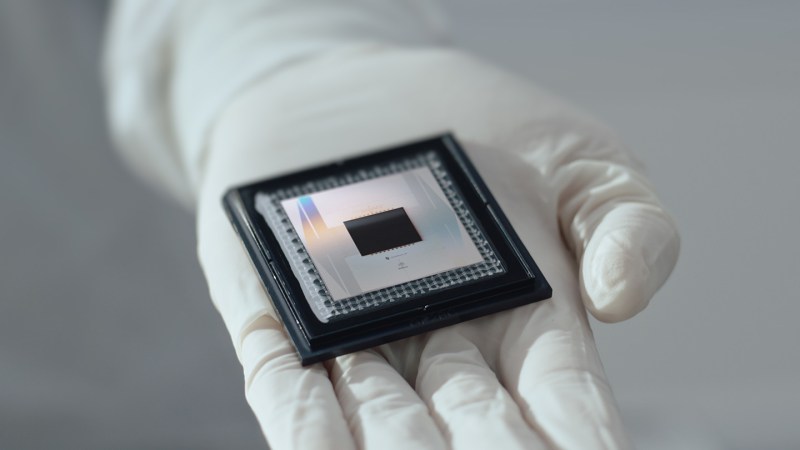
Researchers have reported a significant advancement in quantum computing, claiming that Google’s Willow quantum chip has achieved verifiable quantum advantage. The announcement, made on October 22, 2023, in the journal Nature, highlights a quantum calculation that traditional classical computers cannot replicate, with results that can be confirmed as correct. This milestone marks a crucial step in demonstrating the practical capabilities of quantum computers.
At a news conference on October 17, physicist Tom O’Brien from Google Quantum AI in Santa Barbara, California, emphasized the importance of verification in quantum computing. “If I can’t prove to you that the data is correct, how can I do anything with it?” he stated. The calculation in question measures a phenomenon referred to as “quantum echoes,” which the Willow chip executed 13,000 times faster than the Frontier supercomputer, one of the most powerful in the world. The full set of calculations would take around 150 years on Frontier, but Willow completed them in just days.
The significance of this achievement lies in the verification process. Previous claims of quantum advantage have often been undermined by advancements in classical computation that nullify those advantages. According to Scott Aaronson, a computer scientist at the University of Texas at Austin, other claims of quantum advantage have faced challenges in verification efficiency. He pointed out that while some quantum calculations have been verified, the time required grows exponentially with the complexity of the task.
Google’s latest calculation is distinctly more efficient to verify, provided another quantum computer of similar capability is available. Aaronson noted that achieving efficiently verifiable quantum advantage has been one of the field’s significant hurdles in recent years. “This is a decent candidate,” he remarked.
The researchers employed 65 qubits from Willow to conduct the quantum echo calculation. They executed a sequence of random operations on the qubits, then reversed those operations, effectively simulating a return to the initial conditions. This method allows the extraction of a verifiable signal from a chaotic system that would typically obscure information. The complexity of this process makes it difficult for classical computers to replicate successfully.
In a paper posted on arXiv.org, the team, which includes Google researchers and collaborators, described how their technique calculates the spatial arrangement of certain portions of two molecules in three-dimensional space. Their findings correlate with results from traditional laboratory methods, such as nuclear magnetic resonance, although they do not yet surpass classical calculations.
Despite this limitation, Aram Harrow, a quantum physicist from MIT who was not involved in the study, praised the connection of quantum computing to real experimental scenarios. He noted, “Connecting their quantum computer to a real experiment is very nice to see.”
As the field of quantum computing advances, demonstrating verifiable advantages could pave the way for practical applications in various sectors, potentially transforming industries reliant on complex calculations and data encryption. The implications of this breakthrough could be profound, unlocking new possibilities for technology and computation.

Court Ruling Affirms Panama Canal Independence from China

Waldencast PLC Sees 25.7% Drop in Short Interest in January

Selena Gomez Raps Kendrick Lamar’s “Not Like Us” in Viral Clip

Father and Son Reunited in Minnesota After ICE Detention

Top Infrastructure Stocks to Monitor This February

Stars Shine Bright on the Red Carpet at the GRAMMY Awards

URGENT: Flare Injures Goalkeeper Emil Audero in Italian Match

Jane Seymour Celebrates Life at 74, Claims She’s in Her Prime

Mamdani Unveils 50 New Shelter Beds as Cold Weather Claims 14 Lives

University of Hawaiʻi Joins $25.6M AI Project to Monitor Disasters

Foreign Inflows into Japan Stocks Surge to ¥1.34 Trillion

Hudson Williams Gains Popularity as Breakout Star on Heated Rivalry

Boeing’s Merger with McDonnell Douglas: A Strategic Move Explained

$1.25M Grant Advances Hawaiʻi’s Real-Time Hazard Monitoring

Sydney Sweeney Embraces Body Positivity Amid Hollywood Challenges

BOYNEXTDOOR’s Jaehyun Faces Backlash Amid BTS-TWICE Controversy

French Film Explores Group Therapy in ‘Group – The Schopenhauer Project’

Urgent Farewell: Joleen Chaney Leaves Legacy at KFOR
-
Science3 months ago
University of Hawaiʻi Joins $25.6M AI Project to Monitor Disasters
-
Business3 months ago
Foreign Inflows into Japan Stocks Surge to ¥1.34 Trillion
-
 Entertainment2 months ago
Hudson Williams Gains Popularity as Breakout Star on Heated Rivalry
-
 World3 months ago
Boeing’s Merger with McDonnell Douglas: A Strategic Move Explained
-
 Science2 months ago
$1.25M Grant Advances Hawaiʻi’s Real-Time Hazard Monitoring
-
 Entertainment3 months ago
Sydney Sweeney Embraces Body Positivity Amid Hollywood Challenges
-
 Top Stories3 months ago
BOYNEXTDOOR’s Jaehyun Faces Backlash Amid BTS-TWICE Controversy
-
 World3 months ago
French Film Explores Group Therapy in ‘Group – The Schopenhauer Project’
-
 Top Stories3 months ago
Urgent Farewell: Joleen Chaney Leaves Legacy at KFOR
-

 Top Stories3 months ago
Marc Buoniconti’s Legacy: 40 Years Later, Lives Transformed
-

 Lifestyle4 months ago
Kelsea Ballerini Launches ‘Burn the Baggage’ Candle with Ranger Station
-

 Top Stories3 months ago
Carson Wentz Out for Season After Shoulder Surgery: Urgent Update