
Science
Exploring the Multiverse: Physics Theories Challenge Reality

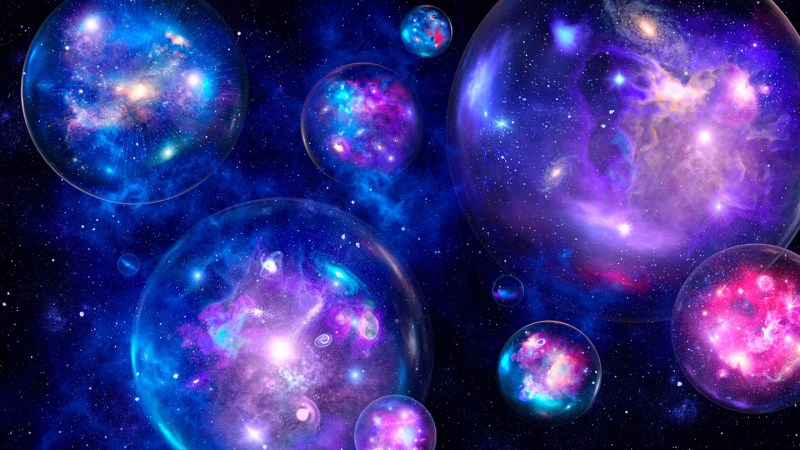
The concept of the multiverse, long a favorite in science fiction, is gaining traction among physicists as a way to address profound questions about our universe. While shows like *Rick and Morty* and the sitcom *Community* portray alternate realities with humor and creativity, serious scientific discussions are emerging around the possibility of multiple, unobserved realms that could fundamentally alter our understanding of existence.
Theories of Cosmic Inflation and Quantum Mechanics
At the heart of this exploration are two prominent theories: one emerging from cosmology and the other from quantum mechanics. According to physicist Andrei Linde of Stanford University, the universe underwent a rapid expansion known as inflation shortly after the Big Bang. This phenomenon caused tiny quantum fluctuations to be stretched across vast distances, influencing the density variations that eventually led to the formation of galaxies.
Linde proposes that these quantum fluctuations could have created regions of space with vastly different physical properties beyond our observable universe. In these unseen areas, particle masses and fundamental forces might differ significantly from those in our own universe. For instance, electrons could be heavier, or gravity could operate under different rules. In such conditions, the existence of life as we know it may be impossible.
Furthermore, Linde suggests that inflation could still be occurring in other parts of the cosmos, generating “bubble universes” with unique characteristics. This idea provides a potential explanation for why the constants of nature in our universe appear finely tuned for life. If a multiverse exists, it is less surprising that conditions suitable for life have emerged somewhere.
Quantum Realities and Measurement Challenges
The second major multiverse theory arises from quantum mechanics, which posits that particles can exist in a superposition of states until they are observed. Physicist Paul Halpern from Saint Joseph’s University explains that traditional quantum mechanics suggests that upon measurement, these possibilities collapse into a single outcome. For example, an electron could be detected in only one location, despite existing in a range of possible positions prior to measurement.
In 1957, physicist Hugh Everett III proposed an alternative view: rather than collapsing into one state, all possibilities may exist simultaneously in parallel realities. This would mean that observers could split into multiple versions of themselves, each witnessing different outcomes. Halpern notes that this theory aligns closely with the multiverse depicted in *Community*, where characters navigate various timelines.
While these theories are intellectually stimulating, they come with significant challenges. Testing the multiverse hypothesis poses difficulties. Halpern points out that there is currently no method to detect the “scars” left by potential collisions between bubble universes, a phenomenon that could provide evidence for their existence.
The prospect of traveling to other universes, if they exist, remains equally elusive. Hypothetical structures known as wormholes could theoretically connect different realities, but Halpern emphasizes that creating such passages would require energy and mass beyond our current capabilities.
Thus, while the allure of teaming up with alternate versions of oneself remains a tantalizing notion, the practicalities of such encounters are far from realization. For now, the exploration of the multiverse remains a domain of theoretical physics, where the boundaries of our understanding continue to expand.
The ongoing discussion surrounding the multiverse not only challenges our perceptions of reality but also invites us to ponder the fundamental nature of existence itself. As scientists delve deeper into these theories, the implications may reshape our comprehension of the universe and our place within it.

Shark Bites Surge Linked to Climate Change and Ecosystem Shifts

NASCAR Clash Delayed Due to Snow, Rescheduled for Monday

Boeing and Lockheed Martin Battle for Fighter Jet Dominance

Golden Link Chapter No. 204 Honors Kijahfha Mahoney with Service Award

Gigachad Price Falls to $0.0025 Amid Market Fluctuations

Exploring Bortus: The Complex Alien of ‘The Orville’

Harry Potter Quiz Links Personality Traits to Entrepreneurship

Colorado Voters React to Trump’s Immigration Actions Amid Midterms

Donaldson Capital Management Boosts Stake in UnitedHealth Group

University of Hawaiʻi Joins $25.6M AI Project to Monitor Disasters

Foreign Inflows into Japan Stocks Surge to ¥1.34 Trillion

Hudson Williams Gains Popularity as Breakout Star on Heated Rivalry

Boeing’s Merger with McDonnell Douglas: A Strategic Move Explained

$1.25M Grant Advances Hawaiʻi’s Real-Time Hazard Monitoring

Sydney Sweeney Embraces Body Positivity Amid Hollywood Challenges

BOYNEXTDOOR’s Jaehyun Faces Backlash Amid BTS-TWICE Controversy

French Film Explores Group Therapy in ‘Group – The Schopenhauer Project’

Urgent Farewell: Joleen Chaney Leaves Legacy at KFOR
-
Science3 months ago
University of Hawaiʻi Joins $25.6M AI Project to Monitor Disasters
-
Business3 months ago
Foreign Inflows into Japan Stocks Surge to ¥1.34 Trillion
-
 Entertainment2 months ago
Hudson Williams Gains Popularity as Breakout Star on Heated Rivalry
-
 World3 months ago
Boeing’s Merger with McDonnell Douglas: A Strategic Move Explained
-
 Science2 months ago
$1.25M Grant Advances Hawaiʻi’s Real-Time Hazard Monitoring
-
 Entertainment3 months ago
Sydney Sweeney Embraces Body Positivity Amid Hollywood Challenges
-
 Top Stories3 months ago
BOYNEXTDOOR’s Jaehyun Faces Backlash Amid BTS-TWICE Controversy
-
 World3 months ago
French Film Explores Group Therapy in ‘Group – The Schopenhauer Project’
-
 Top Stories3 months ago
Urgent Farewell: Joleen Chaney Leaves Legacy at KFOR
-

 Top Stories3 months ago
Marc Buoniconti’s Legacy: 40 Years Later, Lives Transformed
-

 Lifestyle4 months ago
Kelsea Ballerini Launches ‘Burn the Baggage’ Candle with Ranger Station
-

 Top Stories3 months ago
Carson Wentz Out for Season After Shoulder Surgery: Urgent Update