
Science
Earth’s Atmosphere Has Been Nourishing the Moon for Billions of Years

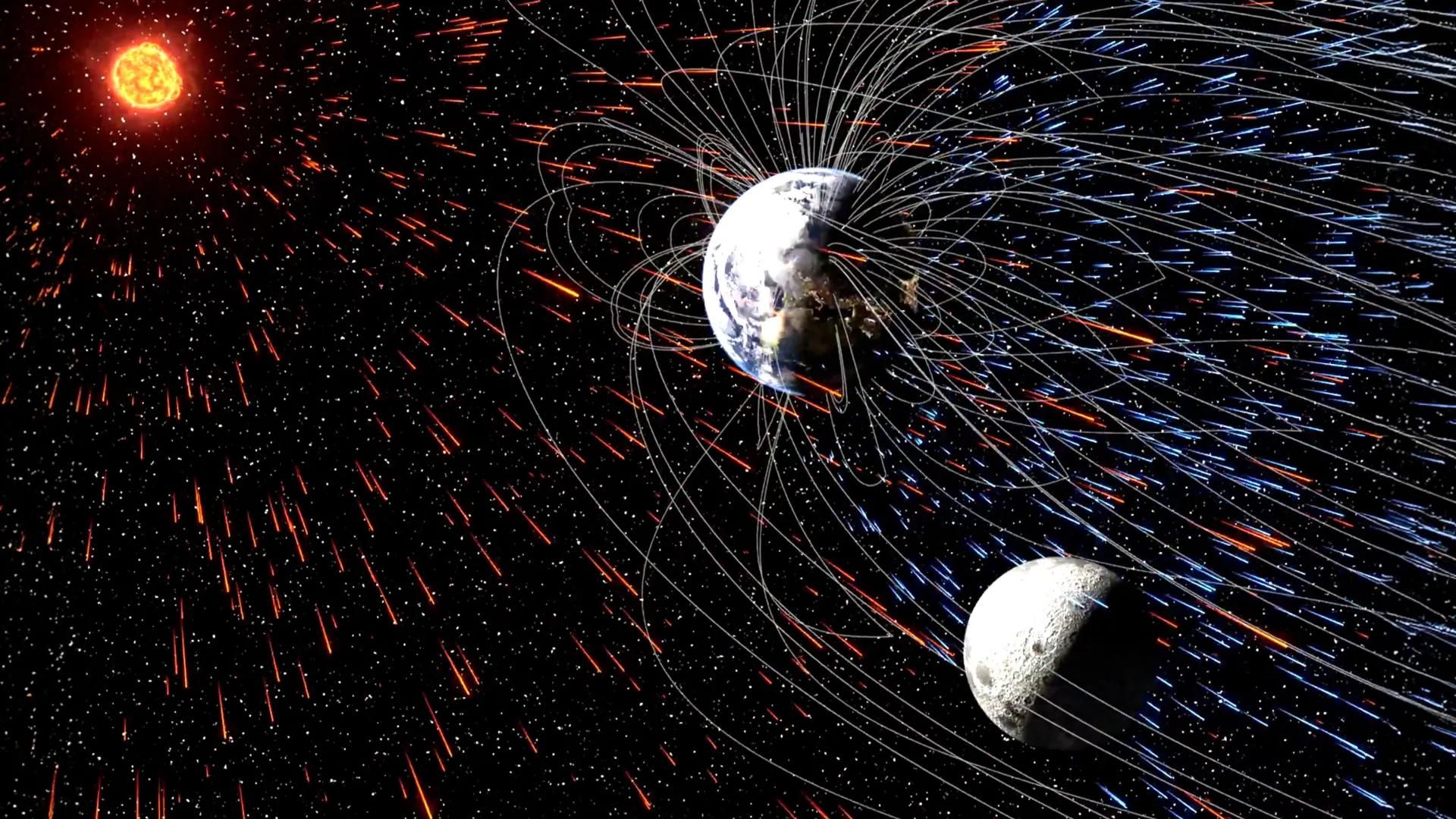
Recent research from the University of Rochester has revealed that Earth has been unintentionally supplying tiny fragments of its atmosphere to the moon for billions of years. Conducted by a team of scientists, the study indicates that Earth’s magnetic field plays a critical role in guiding atmospheric particles to the lunar surface, challenging previous assumptions that such transfers were impossible after the development of this magnetic shield.
The findings, published on January 5, 2026, in the journal Nature Communications Earth and Environment, suggest that rather than blocking particles, the magnetic field funnels them along invisible lines that can extend across the vast distance to the moon. This mechanism may explain the presence of certain gases found in lunar samples collected during the Apollo missions, and it raises the intriguing possibility that lunar soil could serve as a record of Earth’s atmospheric history.
Exploring the Journey of Atmospheric Particles
For millions of years, the moon has seemed devoid of life, yet its surface may carry a complex narrative of Earth’s past. The research indicates that tiny particles from Earth’s atmosphere have been drifting to the moon, where they become embedded in the lunar soil. This could potentially provide resources that support future human activities on the moon’s surface.
Until recently, the scientific community grappled with understanding how these particles could travel such vast distances. The research team, led by Eric Blackman, a professor in the Department of Physics and Astronomy, combined data from lunar soil samples with computational models to trace the interactions between solar wind and Earth’s atmosphere. Blackman emphasized, “By combining data from particles preserved in lunar soil with computational modeling of how solar wind interacts with Earth’s atmosphere, we can trace the history of Earth’s atmosphere and its magnetic field.”
The study highlights that lunar soil may not only preserve an extensive record of Earth’s atmosphere but could also contain valuable resources for future lunar explorers.
Insights from Apollo Missions
The Apollo missions in the 1970s provided crucial data for this study. The samples collected from the moon revealed that the surface layer, known as regolith, contains volatile materials such as water, carbon dioxide, helium, argon, and nitrogen. While some of these substances are known to originate from the solar wind, the quantities of nitrogen detected are too large to be solely attributed to this source.
In 2005, researchers from the University of Tokyo suggested that some of these volatiles could have come from Earth’s atmosphere early in its history, prior to the formation of its magnetic field. They posited that once the magnetic field developed, it would obstruct atmospheric particles from escaping into space. The recent findings from Rochester challenge this perspective, revealing a more complex interaction.
To simulate the journey of atmospheric particles from Earth to the moon, the research team, including graduate student Shubhonkar Paramanick and professors John Tarduno and Jonathan Carroll-Nellenback, conducted advanced computer simulations under two scenarios. One scenario represented an early Earth without a magnetic field, while the other depicted modern Earth with a strong magnetic field and a weaker solar wind. The results demonstrated that particle transfer was significantly more effective in the modern scenario, where charged particles from the upper atmosphere could escape and follow magnetic field lines extending to the moon’s orbit.
This research suggests that the moon could be a repository of Earth’s atmospheric history, offering insights into the evolution of our planet’s climate and potentially aiding long-term human presence on the lunar surface.
The findings also open avenues for understanding atmospheric escape on other planets, such as Mars, which currently lacks a global magnetic field. Paramanick noted, “By examining planetary evolution alongside atmospheric escape across different epochs, we can gain insight into how these processes shape planetary habitability.”
The research was partially funded by NASA and the National Science Foundation, underscoring the importance of this work in the broader context of space exploration and planetary science. As the prospect of human activity on the moon grows, understanding the resources available there becomes increasingly crucial.

Beaufort Man Arrested in Hit-and-Run; Two Pedestrians Injured

KORU Medical Systems Sees 21.4% Drop in Short Interest in January

NASA’s WB-57: High-Altitude Research Aircraft Takes Flight

Chunghwa Telecom Sees 21.6% Drop in Short Interest for January

Claim Your $250 Bet Match NOW for Lakers vs. Knicks Showdown!

Court Ruling Affirms Panama Canal Independence from China

Waldencast PLC Sees 25.7% Drop in Short Interest in January

Selena Gomez Raps Kendrick Lamar’s “Not Like Us” in Viral Clip

Father and Son Reunited in Minnesota After ICE Detention

University of Hawaiʻi Joins $25.6M AI Project to Monitor Disasters

Foreign Inflows into Japan Stocks Surge to ¥1.34 Trillion

Hudson Williams Gains Popularity as Breakout Star on Heated Rivalry

Boeing’s Merger with McDonnell Douglas: A Strategic Move Explained

$1.25M Grant Advances Hawaiʻi’s Real-Time Hazard Monitoring

Sydney Sweeney Embraces Body Positivity Amid Hollywood Challenges

BOYNEXTDOOR’s Jaehyun Faces Backlash Amid BTS-TWICE Controversy

Urgent Farewell: Joleen Chaney Leaves Legacy at KFOR

French Film Explores Group Therapy in ‘Group – The Schopenhauer Project’
-
Science3 months ago
University of Hawaiʻi Joins $25.6M AI Project to Monitor Disasters
-
Business3 months ago
Foreign Inflows into Japan Stocks Surge to ¥1.34 Trillion
-
 Entertainment2 months ago
Hudson Williams Gains Popularity as Breakout Star on Heated Rivalry
-
 World3 months ago
Boeing’s Merger with McDonnell Douglas: A Strategic Move Explained
-
 Science2 months ago
$1.25M Grant Advances Hawaiʻi’s Real-Time Hazard Monitoring
-
 Entertainment3 months ago
Sydney Sweeney Embraces Body Positivity Amid Hollywood Challenges
-
 Top Stories3 months ago
BOYNEXTDOOR’s Jaehyun Faces Backlash Amid BTS-TWICE Controversy
-
 Top Stories3 months ago
Urgent Farewell: Joleen Chaney Leaves Legacy at KFOR
-
 World3 months ago
French Film Explores Group Therapy in ‘Group – The Schopenhauer Project’
-

 Top Stories3 months ago
Marc Buoniconti’s Legacy: 40 Years Later, Lives Transformed
-

 Lifestyle4 months ago
Kelsea Ballerini Launches ‘Burn the Baggage’ Candle with Ranger Station
-

 Top Stories3 months ago
Carson Wentz Out for Season After Shoulder Surgery: Urgent Update