
Science
Astronomers Discover Early Barred Spiral Galaxy from Big Bang Era

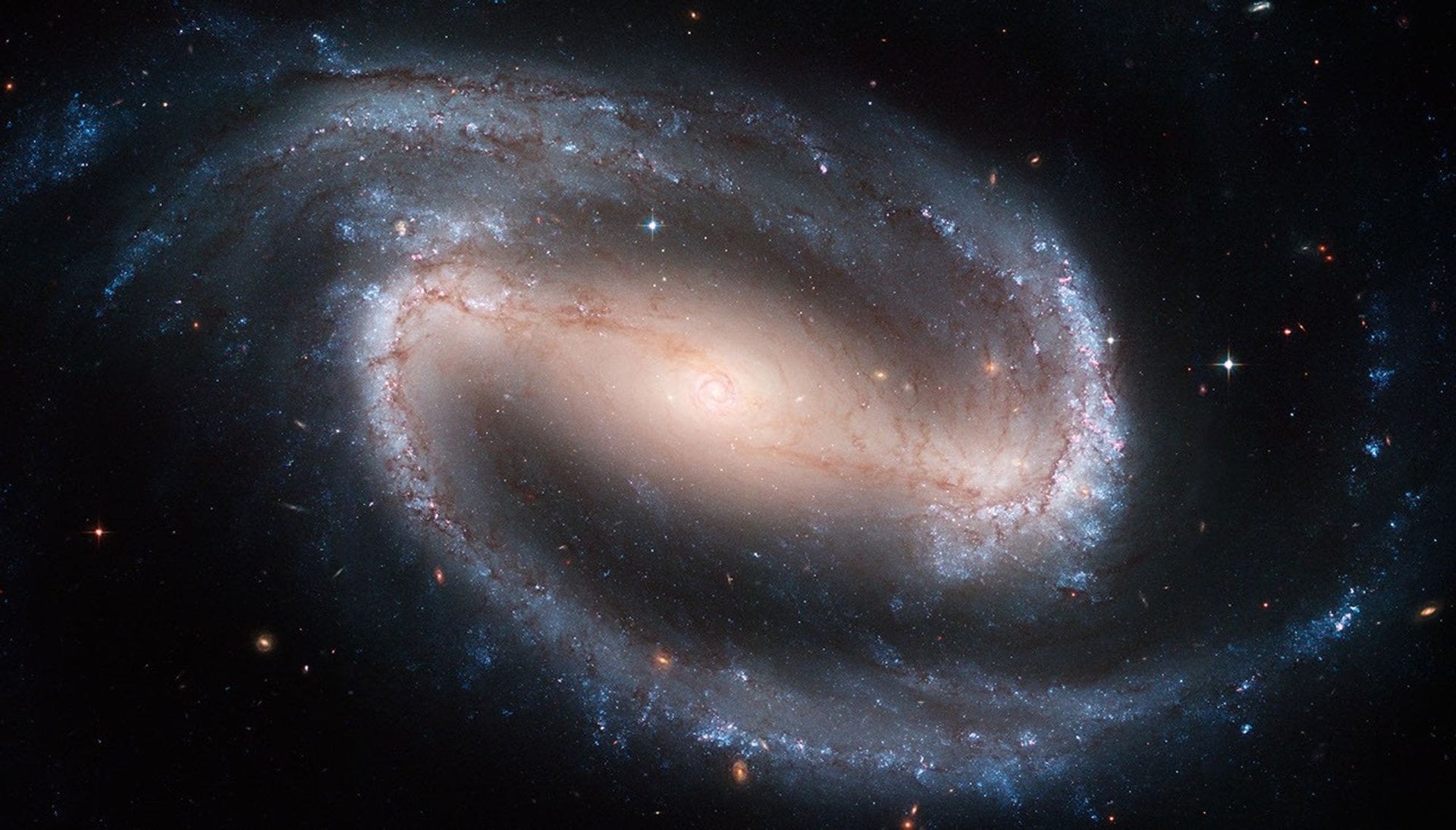
Astronomers have identified what may be the earliest barred spiral galaxy, a significant discovery that sheds light on the evolution of galaxies in the universe. This finding emerged from research led by Daniel Ivanov, a graduate student in physics and astronomy at the University of Pittsburgh. The galaxy, designated COSMOS-74706, existed approximately 11.5 billion years ago, just two billion years after the Big Bang.
Using data from the NASA/ESA/CSA James Webb Space Telescope (JWST), the research team presented their groundbreaking results at the 247th meeting of the American Astronomical Society (AAS) on January 8, 2026, in Phoenix, Arizona. The analysis involved detailed observations made with Webb’s spectrometers, providing a clearer understanding of the galaxy’s age compared to previous methods.
Understanding Barred Spiral Galaxies
Galaxies typically begin as spheroidal masses of stars with minimal gas, dust, or newly forming stars. Over time, they undergo a transformation, merging with other galaxies to develop into spiral forms. These spirals are characterized by their distinctive arms extending from a central bulge. Barred spiral galaxies, such as the Milky Way, feature a linear arrangement of stars across their centers, which are crucial for their evolution. This bar structure helps funnel gas inward, feeding supermassive black holes at the centers and influencing star formation across the galaxy.
While previous reports have mentioned even older barred spiral galaxies, the findings regarding COSMOS-74706 stand out due to the definitive nature of the spectroscopy used. Other studies have relied on gravitational lensing or redshift measurements, which can introduce significant uncertainties, often ranging from 10-15%. In contrast, the spectroscopic approach taken by Ivanov’s team provides a more accurate validation of the galaxy’s existence and age.
Implications for Galactic Evolution
The discovery of COSMOS-74706 is particularly noteworthy within the context of galactic evolution. Some simulations suggest that bars may have formed in galaxies as far back as 12.5 billion years ago, yet observational evidence has been sparse. This new finding helps to refine the timeline of when such structures began to appear, contributing valuable data to the field of astronomy.
As Ivanov noted in a press release from the University of Pittsburgh, this research not only highlights the capabilities of the James Webb Space Telescope but also emphasizes the potential for future discoveries that could further illuminate the early universe’s history. The team’s work represents a significant step forward in understanding the formation and development of galaxies in the cosmos.
This discovery opens new avenues for research and deepens our understanding of the complex processes that have shaped the universe since its inception. The implications of such findings extend beyond astronomy, influencing our grasp of cosmic history and the fundamental mechanisms that govern the formation of celestial structures.

KORU Medical Systems Sees 21.4% Drop in Short Interest in January

NASA’s WB-57: High-Altitude Research Aircraft Takes Flight

Chunghwa Telecom Sees 21.6% Drop in Short Interest for January

Claim Your $250 Bet Match NOW for Lakers vs. Knicks Showdown!

Court Ruling Affirms Panama Canal Independence from China

Waldencast PLC Sees 25.7% Drop in Short Interest in January

Selena Gomez Raps Kendrick Lamar’s “Not Like Us” in Viral Clip

Father and Son Reunited in Minnesota After ICE Detention

Top Infrastructure Stocks to Monitor This February

University of Hawaiʻi Joins $25.6M AI Project to Monitor Disasters

Foreign Inflows into Japan Stocks Surge to ¥1.34 Trillion

Hudson Williams Gains Popularity as Breakout Star on Heated Rivalry

Boeing’s Merger with McDonnell Douglas: A Strategic Move Explained

$1.25M Grant Advances Hawaiʻi’s Real-Time Hazard Monitoring

Sydney Sweeney Embraces Body Positivity Amid Hollywood Challenges

BOYNEXTDOOR’s Jaehyun Faces Backlash Amid BTS-TWICE Controversy

Urgent Farewell: Joleen Chaney Leaves Legacy at KFOR

French Film Explores Group Therapy in ‘Group – The Schopenhauer Project’
-
Science3 months ago
University of Hawaiʻi Joins $25.6M AI Project to Monitor Disasters
-
Business3 months ago
Foreign Inflows into Japan Stocks Surge to ¥1.34 Trillion
-
 Entertainment2 months ago
Hudson Williams Gains Popularity as Breakout Star on Heated Rivalry
-
 World3 months ago
Boeing’s Merger with McDonnell Douglas: A Strategic Move Explained
-
 Science2 months ago
$1.25M Grant Advances Hawaiʻi’s Real-Time Hazard Monitoring
-
 Entertainment3 months ago
Sydney Sweeney Embraces Body Positivity Amid Hollywood Challenges
-
 Top Stories3 months ago
BOYNEXTDOOR’s Jaehyun Faces Backlash Amid BTS-TWICE Controversy
-
 Top Stories3 months ago
Urgent Farewell: Joleen Chaney Leaves Legacy at KFOR
-
 World3 months ago
French Film Explores Group Therapy in ‘Group – The Schopenhauer Project’
-

 Top Stories3 months ago
Marc Buoniconti’s Legacy: 40 Years Later, Lives Transformed
-

 Lifestyle4 months ago
Kelsea Ballerini Launches ‘Burn the Baggage’ Candle with Ranger Station
-

 Top Stories3 months ago
Carson Wentz Out for Season After Shoulder Surgery: Urgent Update