
Science
ALMA and JWST Uncover Secrets of Star Formation in Perseus

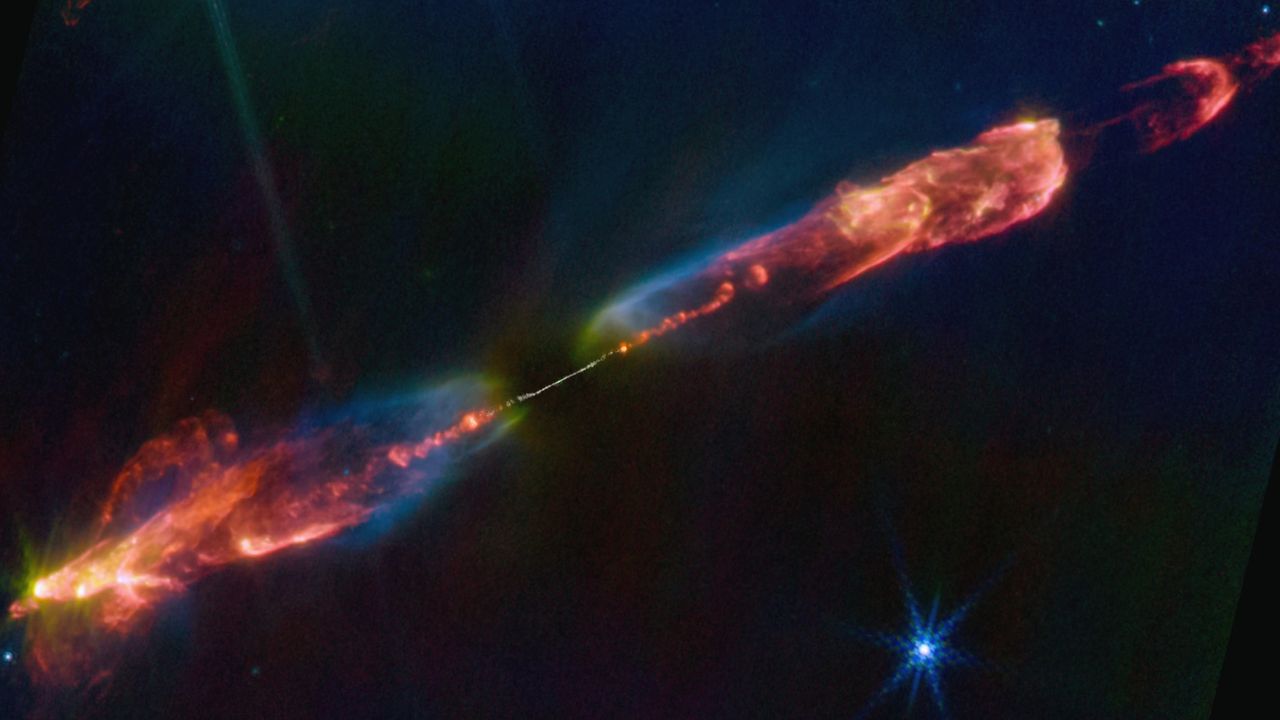
A groundbreaking study has unveiled significant insights into the star formation process, focusing on a young star system known as HH 211, located approximately 1,000 light-years from Earth in the constellation Perseus. This research, published in the journal Scientific Reports on August 13, 2023, utilized data from the Atacama Large Millimeter/submillimeter Array (ALMA) in Chile and the James Webb Space Telescope (JWST) to explore the dynamics of protostellar jets, which play a crucial role in star development.
HH 211 is classified as a Herbig-Haro object—a luminous area formed by energetic jets emitted from newborn stars. At just 35,000 years old, this protostellar system hosts a central protostar with a mass only 0.06 times that of the Sun. The system exhibits a striking bipolar jet, where two beams of ionized material shoot outward in opposite directions, revealing the complex interplay between magnetic fields and star formation.
The research team discovered that the jets from HH 211 travel at speeds reaching around 66 miles per second (or 107 kilometers per second). Despite this rapid movement, the jets rotate slowly, indicating that they are effective in carrying away excess rotational energy from the star’s accretion disk. This finding aligns with existing models suggesting that magnetic fields can assist in launching material away from the star, thereby facilitating its growth.
While jets are typically challenging to observe due to their proximity to the star, the ALMA data provided a unique glimpse into their origins. The study determined that the jets originate from the inner edge of the accretion disk, situated merely 0.02 astronomical units—approximately 1.85 million miles (or 3 million kilometers)—from the protostar itself. This revelation marks the first time researchers have successfully identified the launch site of a protostellar jet.
The ALMA observations were complemented by imaging from the JWST, which captured the vibrant displays of the jets in near-infrared wavelengths. However, the dense cosmic dust surrounding the central region obscured some details critical to understanding the jet’s origins. The integration of ALMA’s submillimeter data with JWST’s infrared images allowed researchers to construct a comprehensive picture of the star formation process.
The collaboration between these two powerful telescopes not only highlights the sophistication of modern astronomical techniques but also emphasizes the significance of protostellar jets in star development. As these jets help regulate the angular momentum within the accretion disk, they enable the smooth infall of material, thereby promoting the growth of new stars.
This research adds valuable knowledge to the ongoing exploration of star formation, which remains one of the most fundamental yet enigmatic processes in the universe. The findings from HH 211 could pave the way for further investigations into how stars are born, ultimately enhancing our understanding of the cosmos.

Shark Bites Surge Linked to Climate Change and Ecosystem Shifts

NASCAR Clash Delayed Due to Snow, Rescheduled for Monday

Boeing and Lockheed Martin Battle for Fighter Jet Dominance

Golden Link Chapter No. 204 Honors Kijahfha Mahoney with Service Award

Gigachad Price Falls to $0.0025 Amid Market Fluctuations

Exploring Bortus: The Complex Alien of ‘The Orville’

Harry Potter Quiz Links Personality Traits to Entrepreneurship

Colorado Voters React to Trump’s Immigration Actions Amid Midterms

Donaldson Capital Management Boosts Stake in UnitedHealth Group

University of Hawaiʻi Joins $25.6M AI Project to Monitor Disasters

Foreign Inflows into Japan Stocks Surge to ¥1.34 Trillion

Hudson Williams Gains Popularity as Breakout Star on Heated Rivalry

Boeing’s Merger with McDonnell Douglas: A Strategic Move Explained

$1.25M Grant Advances Hawaiʻi’s Real-Time Hazard Monitoring

Sydney Sweeney Embraces Body Positivity Amid Hollywood Challenges

BOYNEXTDOOR’s Jaehyun Faces Backlash Amid BTS-TWICE Controversy

French Film Explores Group Therapy in ‘Group – The Schopenhauer Project’

Urgent Farewell: Joleen Chaney Leaves Legacy at KFOR
-
Science3 months ago
University of Hawaiʻi Joins $25.6M AI Project to Monitor Disasters
-
Business3 months ago
Foreign Inflows into Japan Stocks Surge to ¥1.34 Trillion
-
 Entertainment2 months ago
Hudson Williams Gains Popularity as Breakout Star on Heated Rivalry
-
 World3 months ago
Boeing’s Merger with McDonnell Douglas: A Strategic Move Explained
-
 Science2 months ago
$1.25M Grant Advances Hawaiʻi’s Real-Time Hazard Monitoring
-
 Entertainment3 months ago
Sydney Sweeney Embraces Body Positivity Amid Hollywood Challenges
-
 Top Stories3 months ago
BOYNEXTDOOR’s Jaehyun Faces Backlash Amid BTS-TWICE Controversy
-
 World3 months ago
French Film Explores Group Therapy in ‘Group – The Schopenhauer Project’
-
 Top Stories3 months ago
Urgent Farewell: Joleen Chaney Leaves Legacy at KFOR
-

 Top Stories3 months ago
Marc Buoniconti’s Legacy: 40 Years Later, Lives Transformed
-

 Lifestyle4 months ago
Kelsea Ballerini Launches ‘Burn the Baggage’ Candle with Ranger Station
-

 Top Stories3 months ago
Carson Wentz Out for Season After Shoulder Surgery: Urgent Update