
Science
Researchers Use Laser Technology to Capture Black Hole Images

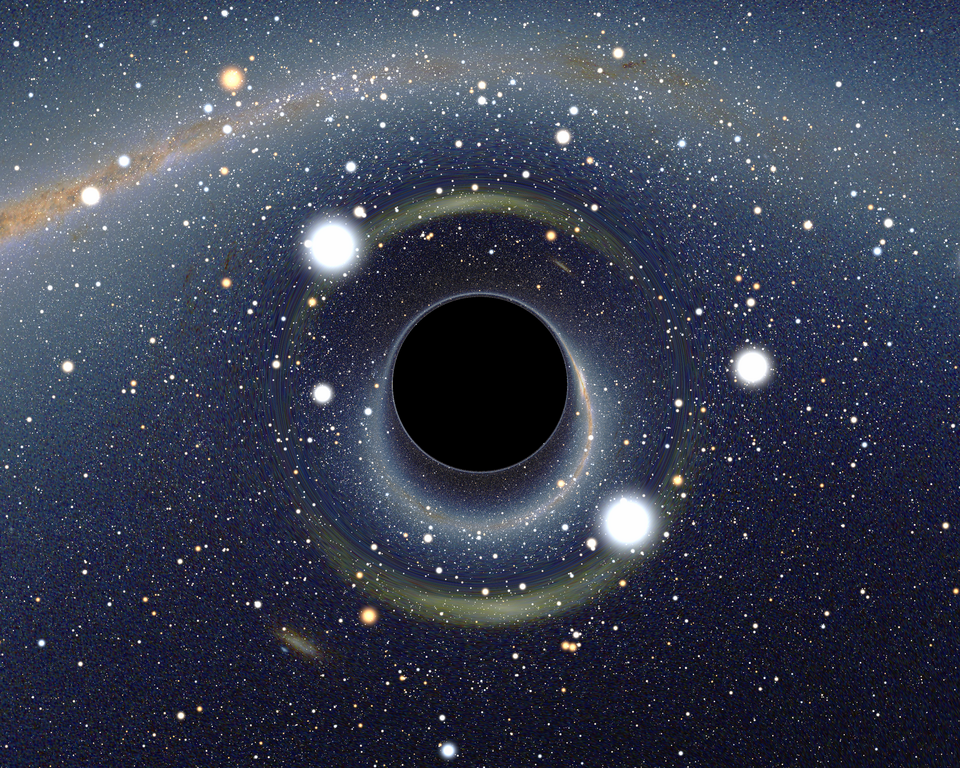
Researchers at KAIST in South Korea have developed a groundbreaking technology that enhances the ability to capture images of black holes. This innovation replaces traditional electronic reference signals used in radio telescopes with laser light, significantly improving synchronization during observations. The advancement aims to solve long-standing challenges in radio astronomy, allowing for more detailed and sharper images of these enigmatic cosmic entities.
Precision Through Laser Light
The challenge of photographing a black hole stems from their extreme distance and compactness. Traditional methods rely on multiple radio telescopes working in concert as a single instrument, requiring precise alignment of signals. The new approach harnesses optical frequency comb lasers, which emit tens of thousands of highly accurate frequencies at regular intervals, akin to a ruler with perfectly spaced markings. This laser technology promises unparalleled precision in measurements, as scientists can tune the intervals with atomic clock accuracy.
Leading the development team, Professor Jungwon Kim from KAIST’s Department of Mechanical Engineering emphasizes that this method fundamentally differs from conventional electronic signaling. By feeding these laser combs directly into radio telescope receivers, researchers establish a common reference point early in the signal processing phase, thus improving the overall stability of the observations.
As astronomers strive to observe at shorter wavelengths to capture finer details, the limitations of electronic methods become increasingly apparent. Electronic signals often fail to maintain the necessary stability, particularly at higher radio frequencies, making precise calibrations challenging. The new laser-based system addresses these issues by allowing telescopes to utilize the inherent stability of light for phase alignment.
Successful Testing and Broader Implications
The KAIST team successfully verified their technology at the Korea VLBI Network’s Yonsei Radio Telescope, where they detected stable interference patterns between telescopes. They subsequently expanded testing to include the KVN Pyeongchang Radio Telescope, demonstrating that the system can function effectively across multiple sites simultaneously.
The implications of this research extend beyond black hole imaging. The same precision timing technology has the potential to enable intercontinental atomic clock comparisons with unprecedented accuracy. It could also enhance measurements in space geodesy, tracking Earth’s subtle movements more effectively, and improve the tracking of deep space probes.
Professor Kim describes this advancement as a means of overcoming the fundamental limits of electronic signal generation by leveraging the optical precision of laser technology. For astronomers aiming to capture clearer images of black holes and other distant celestial objects, this innovation represents a significant leap forward, enabling radio telescopes to operate as one colossal instrument.
This research not only marks a milestone in the pursuit of astrophotography but also opens new avenues for advancing various scientific fields reliant on precise measurements and synchronization.

Colorado Voters React to Trump’s Immigration Actions Amid Midterms

Donaldson Capital Management Boosts Stake in UnitedHealth Group

Researchers Establish First Lab Colony of Invasive Beetle in Australia

Jersey City Schools Confirm Controversial Kindergarten Move

NeuroOne Medical Technologies Outperforms Cannlabs in Financial Metrics

Nevada Bankers Prepare for 2026 Challenges Amid Changing Landscape

Radian Group vs. Principal Financial: An In-Depth Stock Analysis

Clive Davis Gala Honors Ozzy Osbourne as Stars Shine Bright

Sun Valley Music Festival Reveals Star-Studded Lineup for 2026

University of Hawaiʻi Joins $25.6M AI Project to Monitor Disasters

Foreign Inflows into Japan Stocks Surge to ¥1.34 Trillion

Hudson Williams Gains Popularity as Breakout Star on Heated Rivalry

Boeing’s Merger with McDonnell Douglas: A Strategic Move Explained

$1.25M Grant Advances Hawaiʻi’s Real-Time Hazard Monitoring

Sydney Sweeney Embraces Body Positivity Amid Hollywood Challenges

BOYNEXTDOOR’s Jaehyun Faces Backlash Amid BTS-TWICE Controversy

French Film Explores Group Therapy in ‘Group – The Schopenhauer Project’

Urgent Farewell: Joleen Chaney Leaves Legacy at KFOR
-
Science3 months ago
University of Hawaiʻi Joins $25.6M AI Project to Monitor Disasters
-
Business3 months ago
Foreign Inflows into Japan Stocks Surge to ¥1.34 Trillion
-
 Entertainment2 months ago
Hudson Williams Gains Popularity as Breakout Star on Heated Rivalry
-
 World3 months ago
Boeing’s Merger with McDonnell Douglas: A Strategic Move Explained
-
 Science2 months ago
$1.25M Grant Advances Hawaiʻi’s Real-Time Hazard Monitoring
-
 Entertainment3 months ago
Sydney Sweeney Embraces Body Positivity Amid Hollywood Challenges
-
 Top Stories3 months ago
BOYNEXTDOOR’s Jaehyun Faces Backlash Amid BTS-TWICE Controversy
-
 World3 months ago
French Film Explores Group Therapy in ‘Group – The Schopenhauer Project’
-
 Top Stories3 months ago
Urgent Farewell: Joleen Chaney Leaves Legacy at KFOR
-

 Top Stories3 months ago
Marc Buoniconti’s Legacy: 40 Years Later, Lives Transformed
-

 Lifestyle4 months ago
Kelsea Ballerini Launches ‘Burn the Baggage’ Candle with Ranger Station
-

 Top Stories3 months ago
Carson Wentz Out for Season After Shoulder Surgery: Urgent Update