
Science
New Study Reveals Quantum Entanglement Enhances Measurement Precision

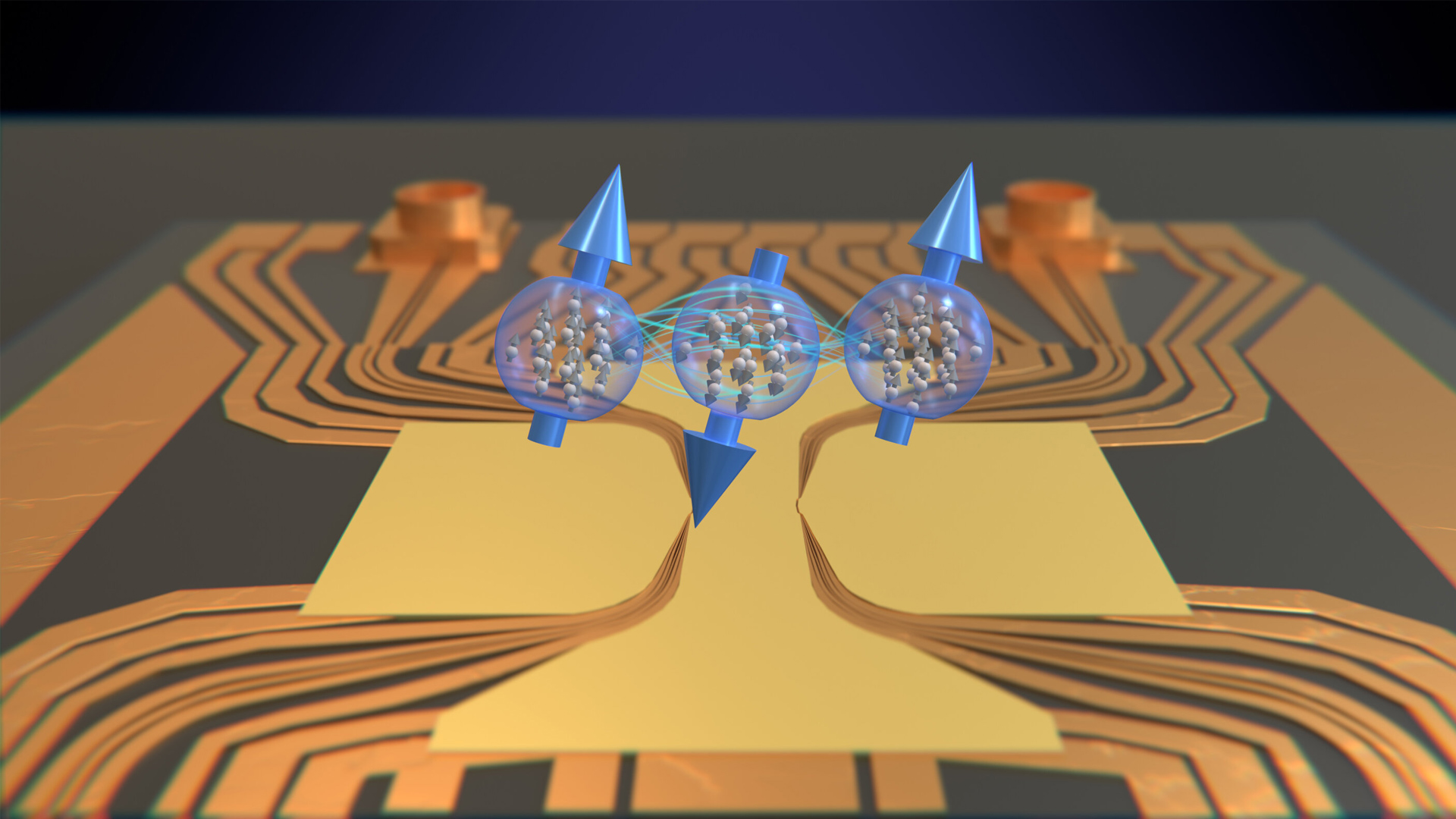
Recent research has demonstrated that quantum entanglement can significantly improve measurement precision in scientific experiments. A team of researchers at the University of Basel has developed a method that allows for more accurate measurements of physical quantities, such as electromagnetic fields and gravity, by utilizing entangled atoms placed in different locations. This breakthrough transforms a previously theoretical concept into a practical application that could enhance some of the most precise measurement tools available today.
The study, published in the journal Science, addresses a longstanding challenge in quantum measurement: the inability to achieve high accuracy when measuring spatial variations across different locations. Traditionally, measuring multiple atoms independently resulted in random fluctuations that limited precision. To overcome this, the researchers employed quantum entanglement, a phenomenon whereby particles become interconnected, allowing them to exhibit correlated behavior even when separated.
In their experiment, the team began with atoms cooled to extremely low temperatures, where quantum effects dominate. Each atom acts like a tiny spinning magnet, with its spin direction influenced by surrounding electromagnetic fields. By entangling the spins of a single cloud of ultracold atoms before separating them, the researchers successfully maintained the entanglement across different locations.
Yifan Li, a postdoctoral researcher involved in the study, noted, “So far, no one has performed such a quantum measurement with spatially separated entangled atomic clouds.” After establishing the entangled state, the researchers divided the cloud into multiple smaller parts, placing them at varying distances. Remarkably, the entanglement persisted even after the separation, allowing the distant atomic clouds to function cohesively as a single quantum system.
This achievement mirrors the long-distance correlations highlighted in the Einstein–Podolsky–Rosen (EPR) paradox. According to Philipp Treutlein, another study author and a professor at the University of Basel, “We have now extended this concept by distributing the atoms into up to three spatially separated clouds. As a result, the effects of entanglement act at a distance, just as in the EPR paradox.”
Through this innovative approach, the separated atomic clouds were able to sense slightly different segments of an electromagnetic field. By integrating data from all locations, the researchers could effectively map how the field varied across space. The entangled nature of the clouds also mitigated the typical quantum uncertainty, enabling disturbances affecting all atoms to largely cancel each other out.
The research team additionally developed the theoretical framework necessary for these measurements, revealing how uncertainty can be minimized when estimating multiple parameters simultaneously using spatially distributed entanglement. This new kind of quantum sensor operates as a coordinated instrument spread out in space, leading to potential advancements in technologies reliant on high-precision measurements.
One promising application of this technique lies in optical lattice clocks, which depend on large numbers of atoms arranged in space to maintain accurate timekeeping. By reducing errors caused by variations in atom positions, these clocks could achieve unprecedented levels of accuracy. The method is also applicable to atom-based gravimeters, which are crucial for detecting variations in gravity across different locations rather than merely measuring its average strength.
Despite the promising results, the proposed method presents technical challenges. Maintaining entanglement while manipulating and controlling multiple atomic clouds necessitates extreme precision and stability. The researchers recognize that extending their technique to cover larger distances or incorporate more measurement points will require significant further development.
The team plans to refine their protocols and test them in real-world precision instruments, aiming to translate their findings into practical applications that could revolutionize fields requiring high-precision measurements.
This research represents a significant advancement in the realm of quantum physics and measurement science, demonstrating the power of entanglement to push the boundaries of what is possible in scientific measurement.

Golden Link Chapter No. 204 Honors Kijahfha Mahoney with Service Award

Gigachad Price Falls to $0.0025 Amid Market Fluctuations

Exploring Bortus: The Complex Alien of ‘The Orville’

Harry Potter Quiz Links Personality Traits to Entrepreneurship

Colorado Voters React to Trump’s Immigration Actions Amid Midterms

Donaldson Capital Management Boosts Stake in UnitedHealth Group

Researchers Establish First Lab Colony of Invasive Beetle in Australia

Jersey City Schools Confirm Controversial Kindergarten Move

NeuroOne Medical Technologies Outperforms Cannlabs in Financial Metrics

University of Hawaiʻi Joins $25.6M AI Project to Monitor Disasters

Foreign Inflows into Japan Stocks Surge to ¥1.34 Trillion

Hudson Williams Gains Popularity as Breakout Star on Heated Rivalry

Boeing’s Merger with McDonnell Douglas: A Strategic Move Explained

$1.25M Grant Advances Hawaiʻi’s Real-Time Hazard Monitoring

Sydney Sweeney Embraces Body Positivity Amid Hollywood Challenges

BOYNEXTDOOR’s Jaehyun Faces Backlash Amid BTS-TWICE Controversy

French Film Explores Group Therapy in ‘Group – The Schopenhauer Project’

Urgent Farewell: Joleen Chaney Leaves Legacy at KFOR
-
Science3 months ago
University of Hawaiʻi Joins $25.6M AI Project to Monitor Disasters
-
Business3 months ago
Foreign Inflows into Japan Stocks Surge to ¥1.34 Trillion
-
 Entertainment2 months ago
Hudson Williams Gains Popularity as Breakout Star on Heated Rivalry
-
 World3 months ago
Boeing’s Merger with McDonnell Douglas: A Strategic Move Explained
-
 Science2 months ago
$1.25M Grant Advances Hawaiʻi’s Real-Time Hazard Monitoring
-
 Entertainment3 months ago
Sydney Sweeney Embraces Body Positivity Amid Hollywood Challenges
-
 Top Stories3 months ago
BOYNEXTDOOR’s Jaehyun Faces Backlash Amid BTS-TWICE Controversy
-
 World3 months ago
French Film Explores Group Therapy in ‘Group – The Schopenhauer Project’
-
 Top Stories3 months ago
Urgent Farewell: Joleen Chaney Leaves Legacy at KFOR
-

 Top Stories3 months ago
Marc Buoniconti’s Legacy: 40 Years Later, Lives Transformed
-

 Lifestyle4 months ago
Kelsea Ballerini Launches ‘Burn the Baggage’ Candle with Ranger Station
-

 Top Stories3 months ago
Carson Wentz Out for Season After Shoulder Surgery: Urgent Update