
Science
SLAC Scientists Uncover Ancient Star Map Using Advanced X-ray Technology

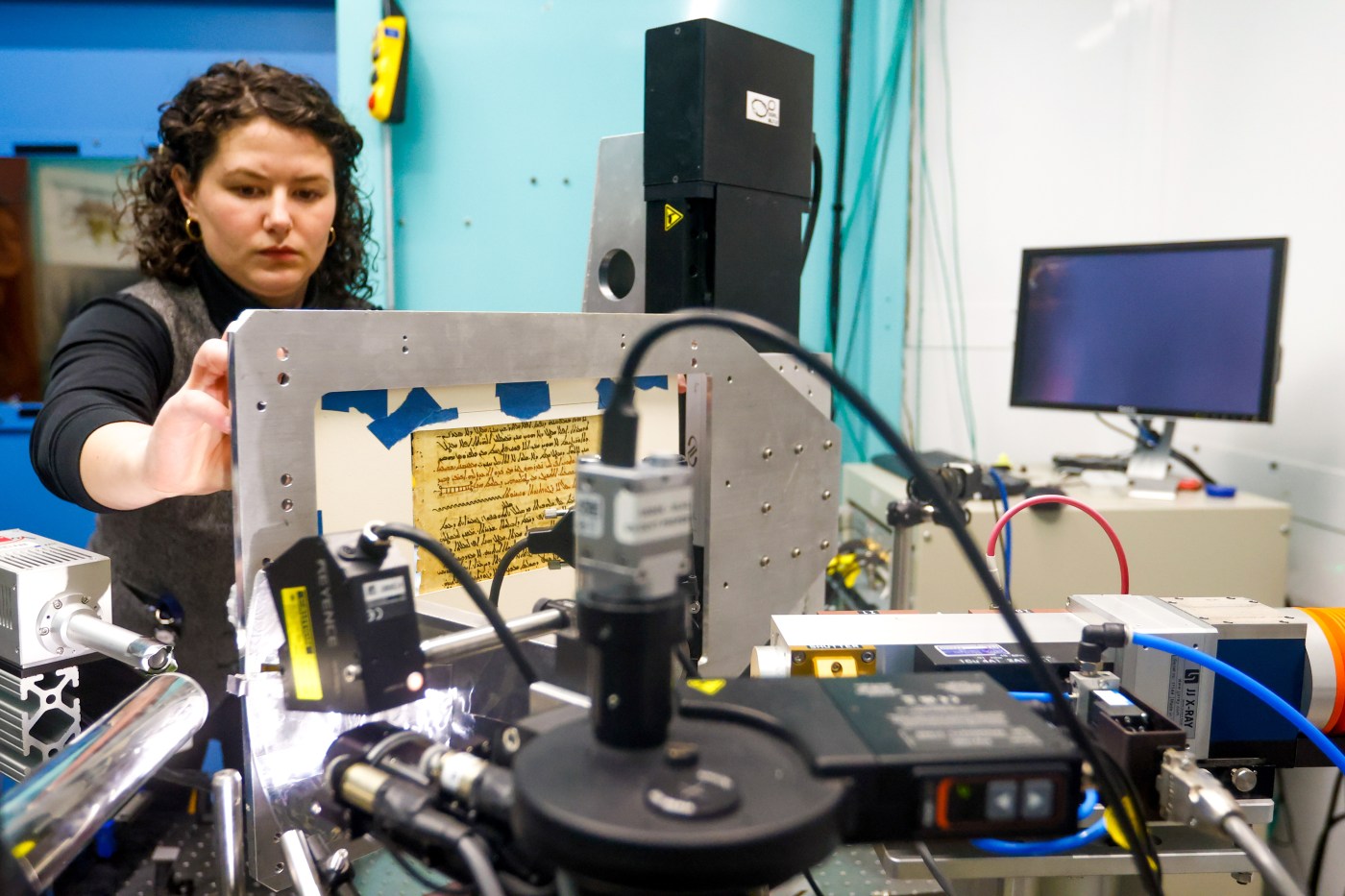
Researchers at the SLAC National Accelerator Laboratory in Menlo Park, California, are employing cutting-edge X-ray technology to investigate ancient parchment believed to contain the world’s oldest star map. This star map, attributed to the Greek astronomer Hipparchus, dates back over 2,100 years and is thought to describe more than 800 celestial bodies based on their brightness and positions in the sky. The original document has never been located, existing only in references made by ancient historians such as Pliny the Elder.
The X-ray examination is focused on pages from the Codex Climaci Rescriptus, a manuscript found at St. Catherine’s Monastery in Egypt’s Sinai Desert. This text, inscribed around the 6th Century, was later overwritten with Christian texts. The importance of this research lies in the potential recovery of Hipparchus’s star map, a significant milestone in the history of astronomy.
Revealing Hidden Treasures
Lead researcher Victor Gysembergh from the French National Centre for Scientific Research expressed his enthusiasm as the X-ray imagery began to reveal ancient Greek text. “We just have line after line of text showing up from the astronomical manuscript,” Gysembergh stated. “I’m hoping to see the first star coordinates pop up. We expect this to be a real game-changer.” The X-ray machine at SLAC is significantly more powerful than standard medical X-rays, allowing scientists to detect faint traces of the original ink that has been partially erased.
The parchment pages were transported to SLAC in a special moisture-controlled case from the Museum of the Bible in Washington, D.C. Each page, roughly the size of a hardcover book, features writing on both sides, including the faded remnants of the star map.
Researchers are carefully scanning one page at a time, using a high-energy X-ray beam to identify chemical signatures of the ink. Minhal Gardezi, a physics researcher from the University of Wisconsin, explained that the ink used in the original star map differs from that of the later Christian writings, allowing for the recovery of Hipparchus’s words through advanced image processing.
Linking Past and Present
The pages of the Codex Climaci Rescriptus represent a unique historical artifact. Originally, these parchment sheets were valuable commodities in the medieval era, often reused for new texts. The star map is believed to have been overwritten around the 10th Century, obscuring its astronomical significance for centuries.
In 2012, a breakthrough occurred when an undergraduate student at the University of Cambridge discovered faint astronomical figures within this Christian manuscript. Follow-up studies indicated that these figures were directly related to the star coordinates recorded by Hipparchus, allowing researchers to connect the dots back to the second century B.C.
As the X-ray machine continues its work, Gysembergh noted the emergence of the word for Aquarius, signaling that they are on the verge of uncovering more details about the constellations and their respective star coordinates. “It could be a section where the manuscript is counting how many stars there are in a constellation, which would be great,” he remarked.
The ongoing work at SLAC not only aims to recover the lost knowledge of Hipparchus but also highlights the laboratory’s role as a leading center for analyzing historical documents using advanced X-ray techniques. In previous years, SLAC has examined other significant texts, including the Gutenberg Bible and ancient Confucian manuscripts, further establishing its reputation in the field of historical document analysis.
This project stands at the intersection of science and humanities, promising to shed light on the early developments of astronomy and our understanding of the night sky as envisioned by one of its earliest pioneers. Researchers are hopeful that the results will reshape historical narratives regarding ancient astronomical practices and their evolution over time.

Shark Bites Surge Linked to Climate Change and Ecosystem Shifts

NASCAR Clash Delayed Due to Snow, Rescheduled for Monday

Boeing and Lockheed Martin Battle for Fighter Jet Dominance

Golden Link Chapter No. 204 Honors Kijahfha Mahoney with Service Award

Gigachad Price Falls to $0.0025 Amid Market Fluctuations

Exploring Bortus: The Complex Alien of ‘The Orville’

Harry Potter Quiz Links Personality Traits to Entrepreneurship

Colorado Voters React to Trump’s Immigration Actions Amid Midterms

Donaldson Capital Management Boosts Stake in UnitedHealth Group

University of Hawaiʻi Joins $25.6M AI Project to Monitor Disasters

Foreign Inflows into Japan Stocks Surge to ¥1.34 Trillion

Hudson Williams Gains Popularity as Breakout Star on Heated Rivalry

Boeing’s Merger with McDonnell Douglas: A Strategic Move Explained

$1.25M Grant Advances Hawaiʻi’s Real-Time Hazard Monitoring

Sydney Sweeney Embraces Body Positivity Amid Hollywood Challenges

BOYNEXTDOOR’s Jaehyun Faces Backlash Amid BTS-TWICE Controversy

French Film Explores Group Therapy in ‘Group – The Schopenhauer Project’

Urgent Farewell: Joleen Chaney Leaves Legacy at KFOR
-
Science3 months ago
University of Hawaiʻi Joins $25.6M AI Project to Monitor Disasters
-
Business3 months ago
Foreign Inflows into Japan Stocks Surge to ¥1.34 Trillion
-
 Entertainment2 months ago
Hudson Williams Gains Popularity as Breakout Star on Heated Rivalry
-
 World3 months ago
Boeing’s Merger with McDonnell Douglas: A Strategic Move Explained
-
 Science2 months ago
$1.25M Grant Advances Hawaiʻi’s Real-Time Hazard Monitoring
-
 Entertainment3 months ago
Sydney Sweeney Embraces Body Positivity Amid Hollywood Challenges
-
 Top Stories3 months ago
BOYNEXTDOOR’s Jaehyun Faces Backlash Amid BTS-TWICE Controversy
-
 World3 months ago
French Film Explores Group Therapy in ‘Group – The Schopenhauer Project’
-
 Top Stories3 months ago
Urgent Farewell: Joleen Chaney Leaves Legacy at KFOR
-

 Top Stories3 months ago
Marc Buoniconti’s Legacy: 40 Years Later, Lives Transformed
-

 Lifestyle4 months ago
Kelsea Ballerini Launches ‘Burn the Baggage’ Candle with Ranger Station
-

 Top Stories3 months ago
Carson Wentz Out for Season After Shoulder Surgery: Urgent Update