
Science
SpaceX Set to Launch 140 Payloads on Transporter-15 Mission

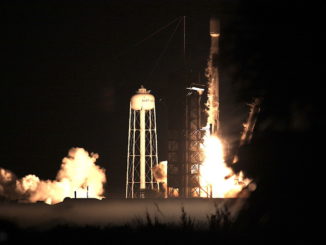
SpaceX is preparing to launch a significant mission, carrying 140 payloads onboard its Falcon 9 rocket from the Vandenberg Space Force Base in California. The launch, part of the Transporter-15 mission, is scheduled for 10:44 a.m. PST on Friday, with liftoff expected to occur after a prior attempt was scrubbed due to issues during the liquid oxygen loading process.
This launch marks the 19th mission in SpaceX’s Smallsat Rideshare program. The Falcon 9 will follow a southerly trajectory upon its departure from Space Launch Complex 4 East, and live coverage will be provided by Spaceflight Now approximately 30 minutes before liftoff.
Mission Details and Payload Overview
The Transporter-15 mission comes after a series of successful rideshare flights earlier this year. SpaceX previously conducted missions in January, March, and June, along with additional rideshare launches in April and November. For this mission, the company will utilize the Falcon 9 first stage booster with the tail number B1071, which is notable for being one of SpaceX’s most frequently flown rockets, marking its 30th flight.
B1071 has previously undertaken five missions for the National Reconnaissance Office and several rideshare flights, including three Transporter missions and NASA’s Surface Water and Ocean Topography (SWOT) mission. Approximately 8.5 minutes after liftoff, the booster will attempt an autonomous landing on the drone ship named ‘Of Course I Still Love You’. This successful landing would represent the 165th landing on this vessel and the 540th booster landing for SpaceX overall.
The deployment of the payloads will start with the Toro2 spacecraft a little more than 54 minutes post-launch and will conclude with the NASA-backed Realizing Rapid, Reduced-cost high-Risk Research (R5) CubeSat nearly two hours later.
Innovative Payload Providers
The rideshare program enables various payload providers to send their spacecraft into orbit at a lower cost compared to dedicated launches. Among these contributors is Seops Space, which utilizes various deployment mechanisms for customer payloads. Seops is responsible for deploying 11 spacecraft on this mission, which includes four payloads from Alba Orbital and three from C3S.
C3S has developed the Mauve satellite, which will study stellar activity to enhance understanding of star behavior and flares. Chad Brinkley, CEO of Seops, emphasized the importance of tailored integration approaches for diverse payloads, stating, “Every mission is different, and our strength lies in tailoring integration approaches for payloads that don’t fit a one-size-fits-all model.”
Also contributing to the mission is Exolaunch, which will deploy 59 customer satellites from the Falcon 9’s upper stage. Notable payloads include the T.MicroSat-1 from Taiwan’s Tron Future Tech and the SPiN-2 CubeSat, supported by the European Space Agency.
At the top of the Transporter-15 stack is the Formosat-8 satellite from the Taiwan Space Agency (TASA), a significant component of a planned eight-satellite constellation designed for optical remote sensing. TASA aims to deploy the full constellation by 2031, launching one satellite each year.
With the anticipation surrounding the Transporter-15 mission, SpaceX continues to demonstrate its leadership in the commercial space sector, expanding access to space for various organizations while pushing the boundaries of satellite deployment technology.

Englewood Church Members Reunite After Thanksgiving Fire

Mayor Names Alan Wong as District 4 Supervisor Amid Controversy

Study Reveals Nitrous Oxide’s Potential in Treating Depression

Walmart Launches Massive Cyber Monday Sales Starting at $5

Rep. Don Bacon Criticizes White House for Lack of Clarity on Ukraine

UK Report Reveals Rise of AI in University Research Evaluation

Florida Hires Jon Sumrall as Head Coach: Implications for FSU Football

Trump Promises to Release MRI Results from October Scan

South Korea Implements Urgent FX Oversight Amid Market Instability

University of Hawaiʻi Joins $25.6M AI Project to Monitor Disasters

Foreign Inflows into Japan Stocks Surge to ¥1.34 Trillion

BOYNEXTDOOR’s Jaehyun Faces Backlash Amid BTS-TWICE Controversy

Carson Wentz Out for Season After Shoulder Surgery: Urgent Update

Marc Buoniconti’s Legacy: 40 Years Later, Lives Transformed

Innovative Surgery Restores Confidence for Breast Cancer Patients

Kelsea Ballerini Launches ‘Burn the Baggage’ Candle with Ranger Station

Steve Kerr Supports Jonathan Kuminga After Ejection in Preseason Game

Chicago’s Viral ‘Rat Hole’ Likely Created by Squirrel, Study Reveals
-
Science4 weeks ago
University of Hawaiʻi Joins $25.6M AI Project to Monitor Disasters
-
Business1 month ago
Foreign Inflows into Japan Stocks Surge to ¥1.34 Trillion
-
 Top Stories1 month ago
BOYNEXTDOOR’s Jaehyun Faces Backlash Amid BTS-TWICE Controversy
-
 Top Stories1 month ago
Carson Wentz Out for Season After Shoulder Surgery: Urgent Update
-
 Top Stories1 month ago
Marc Buoniconti’s Legacy: 40 Years Later, Lives Transformed
-
 Health1 month ago
Innovative Surgery Restores Confidence for Breast Cancer Patients
-
 Lifestyle2 months ago
Kelsea Ballerini Launches ‘Burn the Baggage’ Candle with Ranger Station
-
 Sports2 months ago
Steve Kerr Supports Jonathan Kuminga After Ejection in Preseason Game
-
 Science2 months ago
Chicago’s Viral ‘Rat Hole’ Likely Created by Squirrel, Study Reveals
-

 Lifestyle2 months ago
Dua Lipa Celebrates Passing GCSE Spanish During World Tour
-

 Entertainment2 months ago
Zoe Saldana Advocates for James Cameron’s Avatar Documentary
-
 Politics2 months ago
Dallin H. Oaks Assumes Leadership of Latter-day Saints Church